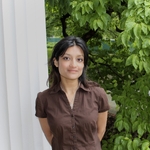
Samira Begum
she/they
Swarthmore College
Economics
Biography
Hello! My name is Samira Begum and I’m an undergraduate student at Swarthmore College studying Economics, Education, and Statistics. I’m interested in digital/technology law, environmental policy, and making technology accessible, interpretable, and secure through AI. I enjoy reading, rock climbing, and skateboarding in my free time.
Academic Status
Undergraduate Student - 4th
Research Area/Department
Computer Science; Data Science; Mathematics; other
Major/Specialty
I'm majoring in Economics and minoring in Education and Statistics. I’m interested in digital law and ethics as it relates to the development of ethical artificial intelligence and machine learning systems. I've considered a graduate school track in this field, using my background in computational economic investigation and math/stat to conduct research at the intersection of artificial intelligence and environmental law. I've chosen my course of study due to it's applicability and practicality outside of academia. I view economics and mathematics as tools for social change that give us the opportunity to uniquely identify data and answer questions about the world around us.
Degrees Earned or in Progress
Bachelor of Arts in Economics with Minors in Education and Statistics (2026)
Academic Preparation
I’ve completed coursework in computer systems, algorithms, advanced statistics, probability, environmental studies, philosophy, and advanced econometrics; all of which have provided me with a strong foundation in ethical reasoning, data analysis, and critical thinking. I’ve also developed strong technical skills in R, Python, Stata, and C/C++ due to my studies. I previously worked for the college information technology department, which granted me the opportunity to apply my academic knowledge of computer systems. I've also worked in library sciences at an institutional archive doing data management, cleaning, and development.
Research/Academic Interests
I'm interested in building AI systems to aid in economic and environmental analysis. A particular project I'm intrigued by is the research on heat islands and the effects of climate change on housing at the LBNL. I recall a group at the 2023 bootcamp working on the “Solar Power for Affordable Housing through Computational Design of Low-Cost/High-Efficiency Solar Cells” project, which I found very interesting! As I looked into the subject, I discovered existing projects at some of the DOE labs that touched on housing development and potential solutions. I’ve grown more interested in the subject as I’ve spoken to people that actually live in places that would be consider “heat islands” and would be interested in approaching this research through a computational and socioeconomic lens. The avenues I’d consider for this project would be rooted in some optimization algorithm-based computation, statistical analysis of data, and/or biological engineering methods. During my research on the work of the NAIRR Pilot Program, I was very interested in the research collaboration on building an AI infrastructure to advance research in reducing poverty and informing social policy! This is the kind of work would bridge my economic and computer science skills while expanding my knowledge on policy. The implementation of AI/tech on policy is important work and I'd love to explore such a project and particularly investigate the diverse unstructured poverty eradication literature. Another potential research idea I’d explore would build off of the work I did over the course of both bootcamps, developing artificial intelligence for HPC education. Our project initially revolved around using AI/ML to evaluate environmental law, but we didn’t have the opportunity to compare the laws against one another to evaluate relative success. My research could involve using Convolutional Neural Networks for Natural Language Processing of environmental policies, allowing me to introduce my math background to my work as well. I’ve also vaguely considered some type of research in energy expenditure/optimization for marine issues such as ocean acidification and access to clean drinking water in regions most affected by oceanic climate change. I’m open to a number of other ideas and believe the versatility of my skills would be well-suited in many different research environments. I’m generally interested in using AI/ML to evaluate particular environmental and/or policy issues and how we can optimize solutions for the betterment of society.
Computational and Data Science Areas
Applied Computer Science; Applied Mathematics; Artificial Intelligence and Intelligent Systems; Climate and Global Dynamics; Ecology; Economics and Business; Educational Sciences; Hydrology and Water Resources; Informatics, Analytics and Information Science; Infrastructure and Instrumentation; Other Earth and Environmental Sciences; Statistics and Probability; Visualization and Human-Computer Systems; Organization
Motivation
I had the opportunity to attend the Sustainable Horizons Institute HPC bootcamp (Summer of 2023) at the Berkeley National Lab and work on a group project using AI (large language models) for energy justice. My mentors and researchers/staff from other groups highly encouraged me to consider working for the DOE labs, noting that SRP would be a great avenue to do so. I grew very interested in HPC over the course of the conference and heard great feedback from an alumnus of the SRP program! The most inspiring element of that opportunity that pushed me to apply was the genuine interest researchers from the labs had for their work. It would be an incredible opportunity to work on a project I’m curious about, especially with people that will only make that experience better. Additionally, I served as a peer mentor during the second iteration of this bootcamp this summer at the Argonne National Lab. I had the opportunity to reconnect with my peers and research mentors from the previous bootcamp, encourage students emerging in these fields by providing technical and social support, and further develop my technical proficiency in AI/ML systems. Through these experiences, I've learned that my information processing is geared towards logic and pattern recognition. Whether it be consumer decision making in economics, mapping in discrete math, or organizing my academic workflow, I generally find connections and perform academically by thinking abstractly. I’ve developed this sort of mentality over time and through the flexibility of attending a liberal arts college. In a matter-of-fact way, I like things that make sense – and computational work is the exact subject that I believe makes sense to me. It aligns very well with the way I think yet challenges me on the occasions it doesn’t. I’d consider myself goal-oriented, and working through data-driven programs has a tangibility that feels rare in other fields. As I’ve developed an interest in ethics through philosophy, I’ve looked further into computer science and artificial intelligence. Data sciences and AI/ML in the computer science field specifically called me to because of their human element. Despite being a very STEM-centered subject, it feels as though it could be a social science due to its theoretical and applicable nature. Especially given that computers were modelled after humans and data is tracked from details on human behavior. Combining elements of the human and inhuman is part of the work I aspire to do in the tech field! In conjunction with my research areas and interests, a primary motivating principle of applying to this program is getting the opportunity to work with leading researchers in such an emerging and relevant field. Of the people I've met, mostly from the DOE labs, everyone has been incredibly passionate about their and welcoming to newcomers. Additionally, many of the projects I’ve seen across the national lab and NSF websites are issues that align with my interests and skillset. Attending and mentoring for the HPC bootcamps certainly reinforced my desire to work alongside the kinds of people I met!
Lightning Talk Title
Data Science for Social Welfare
Keywords (Maximum 20 words)
social policy; welfare; econometrics; poverty; housing; environmental law; data science; AI infrastructure; ML; energy optimization; climate; hpc education; ecology; information-science