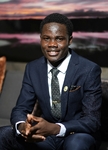
Augustine Manu-Frimpong
He/Him/His
Grambling State University
Computer Science
Biography
Augustine is a junior at Grambling State University majoring in Computer Science. His academic and research interests span Software Engineering, Mathematics, Machine Learning, and Artificial Intelligence. He is particularly interested in combining mathematical modeling and AI to design interpretable, efficient, and scalable systems. During his NSF REU at Louisiana Tech University, Augustine developed an ℓ₁ trend filtering model for financial time series, achieving improved accuracy over the Hodrick–Prescott filter in detecting structural breaks. He is currently conducting research on packet-level anomaly detection, exploring methods such as autoencoders, ensemble learning, and transformer-based architectures for network security applications. Beyond research, Augustine has interned as a Software Engineer at Afterquery, a Y Combinator–backed startup, where he contributed to building scalable data infrastructure tools. He also served as a Software Engineering Fellow at eBay, gaining experience in backend systems and collaborative software development. He has presented his NSF poster work at the US Research Software Engineer Conference (USRSE 2025) and the University of Louisiana System AI in Education Summit (2025), sharing insights on computational modeling and AI adoption in education. Augustine aims to pursue graduate study at the intersection of software engineering, mathematics, and intelligent systems.
Academic Status
Undergraduate Student - 3rd
Research Area/Department
Applied Mathematics; Computer Science; Data Science; Engineering; Machine Learning/AI; Mathematics
Major/Specialty
Computer Science
Degrees Earned or in Progress
B.S. in Computer Science, Grambling State University (Expected 2027)
Academic Preparation
Data Structures and Algorithms Computer Architecture Software Engineering Object-Oriented Programming Machine Learning Deep Learning Database Systems System Design/ Distributed Systems Linear Algebra Numerical Methods Abstract Algebra Probability and Statistics Discrete Mathematics Chemistry Physics
Research/Publications
I conducted research through the NSF Research Experiences for Undergraduates (REU) program at Louisiana Tech University, where I developed and analyzed an ℓ₁ trend filtering model to detect structural breaks in S&P 500 data, comparing its performance to the Hodrick–Prescott filter. The results are being prepared for publication. I am also engaged in an ongoing research project at Grambling State University, focusing on packet-level anomaly detection using autoencoders, ensemble methods, and transformer-based architectures for network security applications. In addition, I have completed several technical projects through coursework and internships, including backend system design, distributed computing, and data infrastructure development during my Software Engineering Internship at Afterquery (Y Combinator startup) and Software Engineering Fellowship at eBay. Presentations: US Research Software Engineer Conference (USRSE 2025) — Presented NSF REU research on trend filtering methods. University of Louisiana System AI in Education Summit (2025) — Presented on AI adoption and student engagement in higher education.
Research/Academic Interests
I am deeply interested in the intersection of software engineering, mathematics, and artificial intelligence. My goal is to understand how mathematical modeling can improve the design and reliability of intelligent systems while maintaining transparency and efficiency. I enjoy studying how abstract mathematical ideas can be translated into practical tools that enhance the performance and interpretability of AI models. My recent research has explored time-series modeling and anomaly detection, where I developed and evaluated trend filtering techniques for financial data and investigated deep learning methods such as autoencoders and transformer architectures for network-level anomaly detection. These experiences have strengthened my appreciation for the balance between theoretical rigor and computational implementation. I am also passionate about the role of software engineering in research, particularly in building reproducible and scalable systems for scientific computing and machine learning. Looking ahead, I hope to continue working at the intersection of mathematics, algorithms, and intelligent systems to develop reliable, interpretable, and high-impact computational solutions.
Computational and Data Science Areas
Applied Computer Science; Applied Mathematics; Artificial Intelligence and Intelligent Systems; Computer Science; Informatics, Analytics and Information Science; Performance Evaluation and Benchmarking; Statistics and Probability; Visualization and Human-Computer Systems
Motivation
Modern research depends on software, yet the people and practices behind that software often remain overlooked. I want to help close that gap by developing systems that make scientific computing more transparent, reliable, and reproducible. My passion lies in understanding how rigorous software engineering can strengthen research itself, turning code into a foundation for discovery rather than an afterthought. That goal is what draws me to the Sustainable Research Pathways program. Participating in the US Research Software Engineer Conference this year opened my eyes to how research software engineers shape the future of science. Hearing their experiences made me think deeply about the balance between innovation and reproducibility, and about the skills required to build sustainable scientific tools. I see the SRP program as the ideal environment to gain that knowledge, learn from mentors who share these values, and contribute meaningfully to ongoing projects. Coming from a smaller institution, I have learned to build opportunities through curiosity and persistence. I hope to use this experience to grow as both a researcher and an engineer, and to contribute to a community that believes inclusive, well-crafted science is the key to lasting impact.
Lightning Talk Title
AI and HPC Integration for Scalable Scientific Workflows
Keywords (Maximum 20 words)
AI for Science; Distributed ML; HPC Systems; Scientific Computing; Numerical Optimization; Workflow Automation; AI–HPC Co-Design; Data-Intensive Science; Applied AI Research