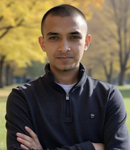
Abdullah Maruf
Dartmouth College
Engineering
Biography
I am an graduate student at Dartmouth College with a master’s degree from same school, specializing in computational materials science with a focus on magnetic materials relevant to Martian mineralogy. My research integrates density functional theory (DFT) simulations with advanced deep learning techniques to investigate the structural, magnetic, and electronic properties of complex oxide systems. I have applied deep learning architectures such as convolutional neural networks (CNNs), graph neural networks (GNNs), and physics-informed neural networks (PINNs) to accelerate property prediction, automate feature extraction, and identify structure–property relationships in planetary-relevant materials. This AI-driven approach enables rapid screening of materials for applications in planetary science and sustainable energy technologies. I hold a bachelor’s degree in Physics, which provided a strong foundation in solid-state physics, quantum mechanics, and numerical modeling. My technical expertise includes high-performance computing, Python-based scientific programming, and machine learning frameworks such as PyTorch and TensorFlow.
Academic Status
PhD Student - 1st
Research Area/Department
Machine Learning/AI; Materials Science; Mathematics; Physics
Major/Specialty
Computational Materials Engineering: Machine learning–driven materials discovery, focusing on deep neural networks (CNNs, GNNs, and transformer architectures) for automated feature extraction, property prediction, and inverse design in inorganic crystalline systems.
Degrees Earned or in Progress
Bachelor’s: Physics & Mathematics. (2022) Master’s: Earth Science — Concentration in Computational Materials Science, focusing on naturally occurring potential novel minerals on Mars. (2024) Ph.D.: Materials Engineering — Graph Neural Network-based automation of materials discovery. (Present)
Academic Preparation
Relevant Graduate Level Courses (Dartmouth): COSC274: Machine Learning COSC278: Deep Learning ENGS110: Signal Processing PHYS116: Quantum Information Science PHYS107: Relativistic Quantum Field Theory ENGS137: Molecular Design with Density Functional Theory ASTR174: Astrophysics EARS202: Critical Analysis in Earth Sciences Undergraduate Level Courses (SDSU): CSC250: Computer Science II MATH323: Discrete Math MATH315: Linear Algebra MATH316: Adv. Linear Algebra MATH321: Differential Equations MATH374: Scientific Computing STAT453: Bayesian Statistics STAT445: Nonparametric Statistics
Research/Publications
Co-Author – Generalized Mixup Model (submitted at a conference): https://github.com/Maruf001/generalized_mixup_model/blob/main/From%20Confusion%20to%20Clarity%20%E2%80%93%20Generalized%20Mixup.pdf Contributor – OM Software for beamline data processing (in-real time): https://github.com/omdevteam/om Google Scholar: https://scholar.google.com/citations?hl=en&user=SxrfWkIAAAAJ
Research/Academic Interests
My research and academic interests are centered on the application and development of deep learning models for advancing discovery in computational materials science, Earth/planetary science, and quantum information science. I am particularly fascinated by deep neural network architectures – ranging from convolutional neural networks (CNNs) and graph neural networks (GNNs) to physics-informed neural networks (PINNs) – and their potential to address domain-specific scientific challenges. For example, super-resolution models such as ESRGAN and SRGAN have powerful applications in enhancing resolution and reducing noise in microscopy and spectroscopy datasets, including TEM and synchrotron experiments. Integrating these methods into data processing pipelines opens exciting possibilities for accelerating analysis and enabling new physical insights. From a theoretical standpoint, I am deeply interested in designing architectures that integrate physical constraints, symmetry operations, and domain-specific priors directly into a model’s inductive bias. This includes developing PINNs and GNNs that can explicitly represent crystal structures, lattice symmetries, and phase transitions, allowing the network to capture essential physics while learning from data. I am equally passionate about leveraging high-performance computing (HPC) for scaling these models, optimizing training across multi-GPU and distributed environments, and solving large-scale inverse problems. My long-term goal is to bridge experimental data with physics-grounded AI algorithms, enabling deeper understanding and faster discovery in planetary-relevant materials and astrophysical systems.
Computational and Data Science Areas
Applied Computer Science; Applied Mathematics; Astronomy and Planetary Sciences; Atmospheric Sciences; Computer Science; Condensed Matter Physics; Geology and Solid Earth Sciences; Materials Engineering; Other Computer and Information Sciences; Other Earth and Environmental Sciences; Other Engineering and Technologies; Statistics and Probability
Motivation
Since my undergraduate years as a physics major, I have always been drawn to pursuing problems that spark curiosity and push me to learn more. Early on, I was fascinated by condensed matter physics, solid-state systems, and computational approaches to physical problems. My journey led me into sustainable energy research and, over time, into computational materials science – exploring Martian planetary materials, and quantum information science. Each new direction revealed a broader landscape of possibilities that I never imagined when I first began. As I gained experience, I became deeply interested in the power of deep learning and machine learning to accelerate scientific discovery. I have been fortunate to work on challenging projects and to learn from advanced courses and research experiences that strengthened both my theoretical and computational skills. More importantly, I have been incredibly fortunate to work with mentors whose guidance, encouragement, and generosity have shaped my growth as a rising scientist. Their influence has instilled in me not only a desire to pursue knowledge for its own sake, but also a responsibility to contribute to a thriving and supportive scientific community. If given the opportunity, I hope to continue this collaborative spirit by contributing my skills to meaningful scientific problems, from developing innovative AI-driven workflows to addressing pressing challenges in current scientific research. Through this experience, I hope to be able to inspire the next generation of researchers – especially first-generation college students and those from underrepresented backgrounds – by fostering a more inclusive and supportive scientific community where all voices are heard, valued, and empowered to thrive.
Lightning Talk Title
Scientific AI-Agent Development on HPC
Keywords (Maximum 20 words)
LLM-agents, surrogate-model, multi-agent-orchestration, scientific-software, FNO, PINN, HPC, CUDA, MeshGraphNet, GNN, LangGraph, Docker/Podman, SLURM/Kubernetes, PyTorch/FSDP, evals