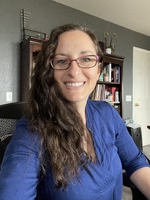
Kathryn Maupin
Sandia National Laboratories
Optimization and Uncertainty Quantification
Biography
Kathryn Maupin is a Principal Member of the Technical Staff at Sandia National Laboratories. Motivated by a passion for transforming uncertainty into actionable insights, Kathryn leverages her extensive expertise in model validation, model form error quantification, and Bayesian analyses to drive innovative solutions that enhance research outcomes. Kathryn earned her PhD in Computational Science, Engineering, and Mathematics, along with her M.S. in Computational and Applied Mathematics, both from The University of Texas at Austin. Her fascination with mathematical modeling began at the University of California, San Diego, where she completed her B.A. in Applied Mathematics. When she is not immersed in data and algorithms, Kathryn enjoys the chaos of family life with her three children and three dogs. Looking ahead, Kathryn aspires to continue pushing the boundaries of computational science while encouraging others to confront ubiquitous uncertainty in their work.
SRP Project Title
Uncertainty Quantification of Displacement Damage Models
Topical Areas
Applied Computer Science; Applied Mathematics; Computer Science; Other Computer and Information Sciences; Particle and High-Energy Physics; Statistics and Probability
Abstract
As the third pillar of science, computational simulation has allowed scientists to explore, observe, and test physical regimes previously thought to be unattainable. High-fidelity models are derived from physical principles and calibrated to experimental data. However, missing or unknown physics and measurement, experimental, and numerical errors give rise to uncertainties in the model form and parameter values in even the most trustworthy models. Thus, rigorous calibration and validation of a computational model is paramount to its effective us as a predictive tool. The popularity of the Bayesian paradigm stems from its natural integration of measurement and model uncertainties. A systematic approach to model validation, progressing from parameter and quantity of interest identification to sensitivity analysis, calibration, and validation, is applied to a drift-diffusion simulation code called Charon. Charon allows the computational qualification of semiconductor devices subjected to displacement damage. *Sandia National Laboratories is a multimission laboratory managed and operated by National Technology & Engineering Solutions of Sandia, LLC, a wholly owned subsidiary of Honeywell International Inc., for the U.S. Department of Energy’s National Nuclear Security Administration under contract DE-NA0003525.
Desired Skills
Coding (any language), Command Line Interface, Desire to learn
Lightning Talk Title
Uncertainty Quantification of Displacement Damage Models
Keywords
Bayesian methods; model calibration; model validation; uncertainty quantification; model discrepancy; model form error.