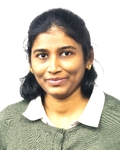
Vijayalakshmi Saravanan
she/her/hers
Assistant Professor
Electrical and Computer Engineering
University of Texas at Tyler
Biography
Dr. Vijayalakshmi Saravanan is an Assistant Professor in the Department of Electrical and Computer Engineering at the University of Texas at Tyler and an Adjunct Professor at the UTD. She previously served as a Visiting Faculty Scientist at Brookhaven National Laboratory (BNL), New York. She earned her Ph.D. in Computer Science and Engineering through the Erasmus Mundus EU Fellowship, conducting research at Mälardalen University (Sweden) and Ryerson University (Canada), and completed postdoctoral research at the University at Buffalo (SUNY) and the University of Waterloo as a Schlumberger Faculty for the Future Fellow. Her research focuses on high-performance computing with AI (HPC-AI), power-aware processor design, big data analytics, and hardware/software co-design for multicore systems. As Principal Investigator, she leads a DOE ASCR-funded project on HPC and machine learning-driven storage for multimodal scientific data, along with a UT System Rising Star Award, totaling over $1M in funding, and has also contributed to DOE’s SRP-HPC Fellowship. An ACM Distinguished Speaker and Senior Member of ACM and IEEE, Dr. Saravanan serves on the DISCOVER-US Steering Committee, has held leadership roles with IEEE WIE, Chair, N2WOMEN, and actively promotes STEM through Women in Big Data, Women in Computer Architecture, and Women in HPC.
Degrees Earned
Doctor of Philosophy (Ph.D.) in Computer Science and Engineering, VIT University, India September 2009 – 2014. Advisors: Dr. Sasikumar Punnekkat, Dr. Anpalagan Alagan and Dr. D.P. Kothari • Doctoral Exchange Student, Mälardalen University, Sweden September 2009 – 2011 • Doctoral Exchange Student, Toronto Metropolitan University, Canada Master of Science (M.S.) in Information Technology, MS University (now Anna University) Bachelor of Engineering (B.E.) in Electrical and Electronics Engineering, Bharathiar University (now Anna University), Coimbatore, India
Research Areas
Computer Science; Data Science; Engineering; Machine Learning/AI; Materials Science
Research Interests
My research interests include advancing scientific computing through scalable infrastructures and AI-driven methods for the efficient analysis of multimodal, multidimensional (M3D) data from large-scale simulations and experimental facilities. I focus on reducing time-to-discovery by coupling HPC systems, machine learning, and innovative storage architectures. A central theme of my work is in-situ and in-transit computing, where data analytics and AI models are executed during or alongside simulations to reduce expensive data transfers. I develop HPC (High-performance computing)-AI powered storage solutions, including multi-tier designs, in-memory file systems, and intelligent caching strategies that optimize I/O performance, throughput, and energy efficiency. I also investigate the energy efficiency of multimodal large language models (MLLMs) in scientific workflows. By applying compression, quantization, and co-design techniques, I align MLLMs with HPC micro-architectures such as GPUs and emerging accelerators, enabling scalable yet sustainable deployment. Overall, my work integrates storage-aware design, micro-architectural optimizations, and energy-efficient AI methods into scientific domains such as NWChem, molecular dynamics and E3SM and Aligned with NAIRR priorities and FAIR principles, my research advances the next generation of scalable, trustworthy, and energy-efficient scientific computing.
Topical Areas
Applied Computer Science; Artificial Intelligence and Intelligent Systems; Computer Science; Electrical, Electronic, and Information Engineering; Health Sciences; Informatics, Analytics and Information Science; Other Computer and Information Sciences; Other Earth and Environmental Sciences; Performance Evaluation and Benchmarking
Research Synergy
My research interests intersect strongly with the goals of the SRP, particularly in enabling scalable, trustworthy, and energy-efficient scientific computing. My work on multimodal, multidimensional (M3D) data analysis using AI/ML aligns with the need to handle increasingly complex datasets generated by simulations and experimental facilities. In particular, my focus on in-situ and in-transit workflows complements project leaders’ efforts by reducing data movement bottlenecks and accelerating discovery in HPC environments. I also bring expertise in developing HPC-AI powered storage solutions, such as multi-tier architectures and in-memory systems, which directly support the performance and reliability of large-scale scientific workflows. My ongoing research on the energy efficiency of multimodal large language models (MLLMs) and their co-design with HPC micro-architectures complements the SRP emphasis on sustainable, high-performance computing. Together, these directions create clear synergies with project leaders’ work in scientific data processing, AI/ML integration, and HPC system design. By pairing my group’s expertise in M3D data-driven computing with SRP’s collaborative framework, I envision faculty/student teams contributing to next-generation solutions that advance DOE mission science through scalable, storage-aware, and AI-enhanced HPC systems.
Motivation
I have had a truly rewarding research experience through the SRP-HPC ECP 2022-2024 programs. This opportunity enabled collaboration with BNL and LBNL scientists and participation in the Hackathon, where we engaged in collaborative GPU computing programming to advance our project. The mentorship and support from the BNL research team were invaluable, and I am confident that these collaborations will positively impact my academic career by fostering funding opportunities and publications. Building on this experience, my team and I continue to work on the collaborative project for SRP 2024, which has motivated me to participate again. My connection with SRP-HPC spans over a decade. In 2011, I attended the BE program and presented a poster, an experience that was both inspiring and transformative as I was surrounded by accomplished women in computing whose achievements motivated me to pursue my own path in the field. That exposure motivated me to encourage colleagues and students, particularly women and minority students, to pursue computer science and STEM careers. As a person with a disability, I understand the challenges faced by underrepresented groups and actively support initiatives like the Women Mentorship Program, IEEE-WIE, and ACM-W, sharing my experiences to help students navigate and sustain their interest in computing. As a senior IEEE member and former IEEE WIE chair (2009–2015, VIT affinity group), I have volunteered as a mentor to discuss my SRP-HPC experiences, highlighting the importance of women in computing. My ongoing participation in SRP 2022–2024 has provided invaluable opportunities to collaborate with DOE lab leaders, expose my students to high-impact scientific computing research, and strengthen long-term partnerships. Our expertise in M3D data analysis, in-situ/in-transit workflows, HPC-AI storage solutions, and energy-efficient multimodal LLMs aligns well with national lab priorities, leading to productive collaborations and sustained research directions. The SRP community has been especially meaningful, fostering both scientific growth and mentorship. Through SRP, my students gain hands-on experience, expand professional networks, and explore pathways to careers in scientific computing. As a faculty member, these engagements have enhanced the visibility of my work within the DOE/NSF ecosystem and shaped my research trajectory. By participating again, I aim to deepen collaborations, explore new synergies in HPC-AI and scientific data workflows, and contribute actively to the SRP community. Importantly, I hope to provide my students with continued access to this enriching environment, where diversity strengthens innovation and all voices are valued.
Supervising Students Plan
I will mentor my student team through structured guidance and hands-on research. Students will have clear, goal-oriented tasks aligned with project priorities and their skill development. Weekly group meetings and one-on-one check-ins will track progress and provide feedback. Students will take ownership of coding, data analysis, or experiments, while I ensure integration with the overall project. I will emphasize reproducibility, documentation, and performance evaluation. In addition, I will support professional growth through presentations, posters, and active participation in SRP community activities, enabling students to gain technical skills, collaborative experience, and confidence in scientific computing.
Student Merit
In the past, I have mentored nearly nine SRP students at Lawrence Berkeley National Laboratory (LBNL) and Brookhaven National Laboratory (BNL), many of whom have successfully advanced their careers in scientific computing, HPC, and AI/ML research. These students demonstrated strong technical aptitude, curiosity, and the ability to engage in collaborative, high-performance research projects. Their preparedness, diligence, and willingness to learn were key factors in my decision to include them on my SRP teams. Through structured mentorship and hands-on guidance, I helped these students gain expertise in M3D data analysis, HPC-AI storage solutions, in-situ/in-transit workflows, and multimodal LLMs, enabling them to contribute meaningfully to ongoing projects while preparing for future academic and professional opportunities. This track record gives me confidence that the students I select for upcoming SRP teams will thrive and continue this tradition of excellence.
Lightning Talk Title
Scalable HPC Framework for Containerized AI-Powered Scientific Discovery
Keywords
HPC; Scientific workloads; AI;Containerization