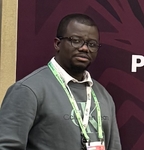
Baboucarr Dibba
he/him/his
Assistant Professor
Mathematics and Data Science
College of Coastal Georgia
Biography
Dr. Baboucarr Dibba is an Assistant Professor of Mathematics and Data Science at the College of Coastal Georgia and a Faculty Affiliate at Lawrence Berkeley National Laboratory. He collaborates with Dr. Damian Rouson on developing neural-network surrogates for cloud microphysics to accelerate climate modeling. His research spans p-adic cellular neural networks, image processing, and explainable AI for healthcare diagnostics, with peer-reviewed publications and invited talks at leading venues such as LatMath, SIAM and QIP etc. Dr. Dibba builds scalable, reproducible tools to enhance climate resilience and improve patient outcomes, while also working to expand access to high-quality STEM education.
Degrees Earned
Ph.D. / Mathematical Statistics and Interdisciplinary Applications / 2025 M.S. / Applied Mathematics / 2021 M.S. / Mathematical Engineering / 2020 B.Sc. (Hons) / Mathematics / 2016
Research Areas
Applied Mathematics; Computer Science; Data Science; Machine Learning/AI; Mathematics; Physics
Research Interests
I study intelligent systems at the intersection of applied mathematics, machine learning, and scientific computing. I build neural-network surrogates for cloud microphysics to accelerate climate models in collaboration with Lawrence Berkeley National Laboratory’s CLaSS group (with Dr. Damian Rouson). I also develop p-adic reaction–diffusion cellular neural networks with delay for modeling and image processing, and explainable AI for healthcare with a focus on early Alzheimer’s risk. Methodologically, my work draws on numerical PDEs, topology optimization, and high-performance, reproducible workflows using FEniCSx, PETSc, Python, and C++. I care about interpretability, uncertainty quantification, and open, reusable software that supports teaching and research. I serve as an Assistant Professor of Mathematics and Data Science at the College of Coastal Georgia and a Faculty Affiliate at LBNL.
Topical Areas
Applied Computer Science; Applied Mathematics; Artificial Intelligence and Intelligent Systems; Atmospheric Sciences; Climate and Global Dynamics; Informatics, Analytics and Information Science; Statistics and Probability
Research Synergy
My team’s strengths align with SRP’s computational, AI, and data-centric projects. Surrogate modeling for cloud microphysics pairs naturally with atmospheric and climate modeling efforts; our numerical-PDE and optimization background supports stable, efficient training and evaluation on HPC systems. Techniques from p-adic CNNs (structure, stability, sparsity) inform model design and regularization that can transfer to other NAIRR-aligned AI tasks. In healthcare, our explainable models and uncertainty analysis complement projects seeking trustworthy predictions. Because we build open, reproducible workflows, our tools can be adopted by lab partners and adapted by student collaborators across disciplines.
Motivation
I’m applying to SRP to deepen collaborations at the lab interface and to give my students a high-impact, mentored research experience. In climate, faster and more faithful microphysics surrogates can help communities plan with better forecasts. In healthcare, interpretable risk models can support earlier, fairer decisions for Alzheimer’s disease. SRP’s mission to build inclusive communities where everyone thrives matches how I teach and mentor: open tools, clear documentation, and reproducible workflows so students can contribute meaningfully. I hope to co-design a summer project that couples rigorous math/ML with real-world deliverables, and to continue that collaboration into the academic year through publications, software contributions, and student pipelines into national projects.
Supervising Students Plan
I will meet with the team twice weekly (stand-up + technical session) and maintain a shared project board (issues, milestones, code reviews). Students will work in paired roles (modeling + evaluation) and rotate responsibilities to build breadth. We will use a reproducible stack (conda/uv, pinned deps, Makefiles), code reviews with tests, and short memos for design decisions. Mid-summer and end-summer checkpoints will include a talk, a brief report, and a cleaned repository with docs. I will coordinate with the project leader for weekly alignment and ensure students have specific, scoped tasks tied to upstream research goals.
Student Merit
Georvasilis Alexios is a final-year student majoring in Applied Mathematics and Data Science. He has demonstrated strong academic performance, earning A grades in Machine Learning, Numerical Analysis, and Python for Data Analytics. He is proficient in Python and works comfortably with libraries such as NumPy and Pandas. In class, he built a small solver and showed enthusiasm for learning FEniCSx, indicating a readiness to deepen his computational skills. Georvasilis has solid introductory experience in machine learning and completed a well-documented project in my course, showcasing persistence, clear communication, and attention to detail. He is well-prepared to contribute to tasks such as data preparation, baseline model development, and reproducible evaluation workflows. His focus will be on implementing operators, running controlled experiments, and writing unit tests to ensure the reliability of the codebase.
Lightning Talk Title
Neural Network surrogate modeling for Atmospheric Cloud Microphysics
Keywords
Neural network surrogate modeling Atmospheric cloud microphysics Surrogate model development HPC optimization Model training and evaluation Reduced computational cost