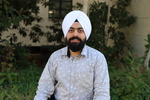
Amneet Pal Bhalla
he/him
Associate Professor
Mechanical Engineering
San Diego State University
Biography
Dr. Amneet Bhalla obtained his Ph.D. in Mechanical Engineering from Northwestern University in 2013, and his Bachelors (2004-2008) and Masters (2009) in Mechanical Engineering from the Indian Institute of Technology at Kharagpur. He has postdoctoral training at the University of North Carolina at Chapel Hill (Mathematics Department) and Lawrence Berkeley National Laboratory (Computational Research Division). He also has industrial experience at ExxonMobil Upstream Research Company where he worked as a computational research engineer. In his research, Dr. Bhalla develops numerical methods and high performance computing techniques for computational fluid dynamics and computational fluid-structure interaction problems. His research includes developing mathematical models for flow phenomena in engineering devices and processes, and using novel simulations to interrogate the underlying physics of the problem, with the aim of improving and optimizing engineering design. Dr. Bhalla is a recipient of the National Science Foundation (NSF) CAREER Award (2022) and the American Society of Mechanical Engineers' (ASME) Rising Star of Mechanical Engineering Award (2024).
Degrees Earned
Ph.D. Mechanical Engineering, Northwestern University, IL (2013) M.Tech. Mechanical Engineering, Indian Institute of Technology Kharagpur, India (2009) B.Tech. Mechanical Engineering, Indian Institute of Technology Kharagpur, India (2008)
Research Areas
Applied Mathematics; Engineering; Mathematics
Research Interests
Fluid-Structure Interaction, Multiphase Flows, Wave Energy Conversion, Dynamics and Controls, Scientific Machine Learning, Aquatic Locomotion, Numerical Methods, High Performance Computing, Scientific Software Design.
Topical Areas
Applied Mathematics; Fluid and Plasma Physics; Hydrology and Water Resources; Mechanical Engineering
Research Synergy
My research group develops numerical techniques for simulating physical processes (e.g., multiphase flows, heat transfer, fluid-structure interaction) described by partial differential equations. I am particularly interested in learning data-driven methods and scientific machine learning techniques which can accelerate the simulation times of such processes. Having a NAIR PI as a project partner would enable me and my student to work on a concrete AI/ML project and broaden our research horizons. Ultimately we aim to develop more efficient and accurate simulations through the integration of the advanced AI/ML methods and software stack learned during the summer program into our research.
Motivation
I have participated in the SRP program before with my PhD students. It was a wonderful experience for both me and my students to work closely with lab scientists on their projects. Our collaboration led to three journal publications. The PhD students gained significant exposure to the lab's computational resources including HPC clusters and HPC software stacks. They also networked with students and faculty from other institutions. This ultimately bolstered their CVs. After defending their doctoral theses, the two students landed jobs at Dassault Systems and Western Digital as full-time research engineers. On a personal level I have wanted to venture into SciML projects for a while now. However, I have not had the opportunity to work in this area due to prior research commitments. I am looking for an experienced PI in this area to learn from. Working on a well-defined AI/ML project under an expert will provide a structured hands-on learning experience. AI/ML is a vast field, evolving quickly, and working with an established PI in the area would prove conducive. I believe that this program will provide my group with the right resources and expertise to break into AI/ML projects.
Supervising Students Plan
During the program I will work closely with the accompanying PhD student and the NAIR principal investigator. We will read the literature the NAIR PI will provide us. I will be responsible for explaining the theory and math to the PhD student who will be in charge of implementing the code and analyzing or cleaning the datasets. In order to discuss results and get feedback on our progress, we will meet weekly with the NAIR PI. Furthermore, I plan to have a Slack channel for communicating with the student and the PI.
Student Merit
The PhD student has been in my lab for the past year and at the time of the SRP program, they would have spent two years in my lab. The student is working on a novel continuum formulation for modeling phase change phenomena with simultaneous occurrences of melting, solidification, boiling, and condensation. The ultimate goal is to simulate metal additive manufacturing processes in a fully-resolved manner to understand the impact of process parameters on the quality of the printed parts. The formulation is implemented by the student in our open-source computational fluid dynamics code IBAMR which is primarily written in C++ and runs on large scale machines. The student has taken several graduate level courses in Mechanical Engineering and Applied Mathematics as part of their doctoral studies.
Lightning Talk Title
A Multiphysics Framework for Modeling Metal Additive Manufacturing Processes
Keywords
Computational Fluid Dynamics; Multiphase Flows; Numerical Methods; Partial Differential Equations